The picture of a Capitalist society created by Marx and Engel is relatively accurate, with a few exceptions. They talk about how the bourgeoisie was originally oppressed, rose up against that oppression, and began oppressing those beneath them, thus starting the cycle all over again. In American society today, each class generally tends to look out for themselves. Marx also talks about how the bourgeoisie has “stripped of its halo every occupation hitherto honored and looked up to with reverent awe” (62). Everything has now been reduced to its monetary value, including people and their jobs. In modern day society, the vast majority of jobs are ones held only so a person can feed their family. There are of course many fulfilling occupations, but most people need to work in jobs they hate just to survive. Marx talks about how the old means of exploitation was through religion, but recently it developed into “direct, brutal exploitation” (62). In a sense this is true. Large modern corporations and companies only look out for themselves, exploiting everything around them. Many pay their workers as little as possible, and are interested in quantity, not quality. As we saw with the oilrig leaking into the gulf, many companies are not concerned with the safety of the environment or their workers, only with saving as much money as possible.
Tuesday, January 25, 2011

Monday, January 24, 2011
Communist Manifesto question
Is Marx and Engels' description of capitalist society accurate? Defend your answer by referring specifically to a characteristic of capitalist society, as Marx and Engels describe it, and with specific reference to modern American (or other capitalist) society. Keep your response brief--a couple hundred words, tops. Feel free to respond to others' posts as well.
Monday, November 15, 2010
The Efficacy and Justification of the Committee of Public Safety
 During the course of the French Revolution, there were many distinct phases that changed both the political and economic direction of the country. First, there was the political change of 1789, which included the desacralization of the monarchy and the creation of a constitutional monarchy, including elections to a newly formed National Assembly. However, as the Revolution progressed, radicalism became every more entrenched in French politics. This caused the National Assembly to disband, and a new Legislative Assembly formed, containing members of the Parisian Jacobin club, a younger and more radical group of politicians. Even later, however, an even more radical group of politicians, known as the Mountain, led by Maximilien Robespierre, controlled the newly formed National Convention, and employed dictatorial tactics to maintain control over the people. The Committee of Public Safety, set up by the National Convention and maintained by Robespierre and his compatriots, utilized effectively brutal techniques during a period known as the Reign of Terror, which eventually contradicted the fundamental principles on which the French Revolution began.
 Robespierre's infamous Committee of Public Safety was a crude but impeccably effective political weapon that forever changed the course of the Revolution by instilling fear in the people and by dictatorially controlling them. Robespierre's Reign of Terror seemed to be blind to any class or political distinction. It broadly combatted any enemy of the state,

and was unhesitant in its arrest of hundreds of thousands of people during the radical phase of the Revolution (McKay, 698). It not only destroyed the political enemies to the new power structure, but also placed fear in the people. Such widespread terror worked "to solidify the home front" (McKay, 698). In essence, the Committee of Public Safety acted to control the people and place their focuses on the Revolution that Robespierre and his allies envisioned. Without such terror, negative sentiment which rose during this time period against war and tyranny might have formally arisen to oppose those in power; however, the implication of dictatorial tactics enabled the country to move forward in its war against Europe, without the worry of such an uprising. In your opinion, did Robespierre and his allies effectively control the populace during the Reign of Terror? Also, do you think that the Committee benefited France, or was it a bad influence to the French?
Even though Robespierre's famous Committee of Public Safety was effective in controlling the French populace, its extermination of thousands of men and women during the course of the Revolution severely repudiated the basic ideals of the Revolution on which Robespierre and other radicals like himself started the Revolution only four years prior. The original French Revolution of 1789, a time when moderate middle class businessmen rallied for individual liberties and republican government, embodied the heart and soul of the Revolution. They overthrew the tyrannical monarchy, established an elected legislative body that represented the people, and confirmed the individual liberties of the people with passage of such documents as the "The Declaration of the Rights of Man and Citizen" (Sherman, 57-58). Contradictory to this was Robespierre's epic Reign of Terror over the people. Courts set up by the National Convention ignored legal procedure and swiftly executed thousands of people at the whims of a few dictatorial leaders (McKay, 698). Robespierre attempted to justify his terror in the "Speech to the National Convention" (Sherman, 60-61); however, he merely stated that terror was necessary for control, not for liberty. Not once did he maintain the core principles of the French Revolution through the employment of the Committee of Public Safety. Moreover, he stated the ideals of the Revolution, but only justified the terror only as necessity for Revolution, never justifying it as compliant with the ideals of the Revolution. He supported Revolution when it suited his ascendancy to power, yet fervently quelled it whenever it threatened his power. The Reign of Terror was a period of time when the original ideals of the Revolution were forgotten, and a new era of bloody dictatorial rule was employed, continuing from then through the fall of Napoleon. Do you think that the actions of the Committee of Public Safety were justified? Did they or did they not embody the ideals of the original French Revolution of 1789?
Friday, November 5, 2010
France's Crusade Against Tyranny

When the french National Assembly disbanded, a new representative body convened in October 1791. However, the members of the former National Assembly were not eligible for election to the new Legislative Assembly. Therefore the Legislative Assembly had different members and a distinctly "different character," (McKay, 695). Specifically, the individual members were younger and more radical than the members of the National Assembly. Subsequently, the new Legislative Assembly was extremely distrustful of monarchy, and thus became increasingly committed to eradicating tyranny from France. In fact, the Legislative Assembly spurred France to become passionately involved in a "war of people against kings," (Mckay, 696). In other words, France was encouraging its people to support a crusade against all European tyranny, and simultaneously declare war on almost all of Europe. In April 1792, France declared war on Francis II, the monarch of Habsburg.
Initially, consequences of such a war were apparent when French forces fled at their first encounter with the armies of the First Coalition. Luckily, the First Coalition did not counterattack France because of their internal conflict about the division of Poland, but if the First Coalition had immediately attacked France, they would have marched harmlessly into Paris. However, some good did come out of this "crusade", because by November 1792, French forces were occupying the entire Austrian Netherlands. Along the way, French forces "abolished feudalism" and attempted to establish republican governments. In a certain respect, France did achieve its goal of exterminating tyranny, although in the end, I believe that France hindered itself much more than aid its cause.
First of all, France was not strategic enough in its international affairs; French armies lived off of the very land that they were "liberating" (by demanding food and supplies from foreigners, and even plundering local treasures). This ultimately caused the French to appear as 'foreign invaders', instead of Liberators. Furthermore, by February 1793, Republican France was at war with Britain, Holland, Spain, Austria and Prussia. This war did not resolve itself until 1815. Secondly, France faced internal protest from peasants who revolted against being drafted into the national army. These peasants clearly wanted to maintain their freedom to choose whether or not to enlist in the army, instead France compromised its own ideals of freedom by creating a military draft. These peasants gained the support of devout Catholics, royalists and foreign agents. Over time, France was gaining more and more opposition. Lastly, the final way in that France hindered itself, was that it was facing an internal revolution at the time of this war against tyranny. Instead of devoting all of its attention towards resolving the internal issues, France engaged itself in a conflict that would not be resolved until 1815. Personally, France could have saved funds, manpower, and energy by not engaging itself in a continental war.
This is my opinion on France's war against tyranny, here are some questions to consider:
What was the purpose of attempting to eradicate all European monarchies? Is there any rational justification of this?
Do you think that this war resulted in success, or was it pointless?
Thursday, November 4, 2010
A Speedy Revolution


After Louis XVI agreed to hold the Estates General for the first time since 1614, he established elections for delegates from each Estate. Within each state, members came together to discuss possible delegates and draft petition for change. Although they did not meet together, the three estates did reach a general consensus: the abolitionist government needed to become a constitutional monarchy where laws and taxes required the consent of Estate Generals. Even though the estates had agreed, the Parliament of Paris announced that the delegates of each estate would sit separately, thus leading to the alliance of the nobles and clergy, and excluding and demeaning the commoners. When the coalition of delegates gathered in May 1789, they met immediate opposition. The third estate refused to work with the clergy and the nobles, until the estates could sit together as a whole. After six weeks a few parish priests relented and joined the third estate. On June 17, the third estate voted to call itself the National Assembly. On June 20, the third estate moved from their hall because of repairs to a large indoor tennis court, where they swore the Oath of the Tennis Court, pledging not to disperse until they had written a new constitution. In the earlier part of Louis XVI reign he was very subdued, but in reaction to the tennis court situation, he ordered the three estates to move together, and resolved the Estates Generals all together.
In 1788, the state of the third estate worsened as a result of an inferior grain crop. The price of bread skyrocketed, thus causing many peasants to spend as much as half of their pay checks on bread. The crisis then lead to the collapse of the need for manufactured goods, which left thousands of people out of work. Further, it was rumored that the king’s troops were prepared to “sac” the city. On July 13, people seized weapons and gunpowder, and on July 14 they stormed to the Bastille tower in order to gather more supplies for the coming of the king’s army. The Bastille tower was a retired medieval fortress that had eighty-eight former retired soldiers and thirty Swiss mercenaries guarding it. When the governor saw the people approaching the tower, he ordered the guards to open fire; ninety eighty people were killed. Finally the governor surrendered (he was later hacked to death and his head was stuck on a pike and paraded through the city), thus causing the king to refute his previous order to the finance minister to disperse his troops. Still, the peasants continued to rebel against society. In the countryside, angry peasants plagued their lords with violence and refused to pay their taxes. The peasants’ uprising caused what is now known as the Great Fear. On August 4th, 1787, a coalition of some liberal nobles and middle-class delegates at Versailles, rebuked all of the nobles’ privilege. The result was an astounding victory for peasants. Moreover, on August 27 1789, the National Assembly issued the Declaration of Rights. Like the Bill of Rights of the American Constitution, the Declaration of Rights guaranteed equality before the law, among many other basic rights. Why did the National assembly relent to third estate aggression so easily? Why was this rebellion so much more successful than Shay’s rebellion of the American Revolution?
While the Declaration of Rights was very progressive and beneficial, the wrath of the peasants continued. On October 5th, some 7,000 women marched from Paris to Versailles demanding action. The women were armed with scythes, sticks, and pikes, and murdered many royal body guards. The women also desperately looked to kill the royal family (especially Marie Antoinette), but the family was saved. The nest day the royal family headed to Paris and for the next two years the National Assembly saw the consolidation of the liberal revolution. In July 1790, Louis XVI reluctantly agreed to a constitutional monarchy. Also, new laws broadened women’s rights to seek divorce, to inherit property, and to obtain financial support for illegitimate children from fathers. Why do you think the women of the French Revolution received rights following the revolution, but the women of the American Revolution did not? Was it because the women of France used violence, or did their violence limit their rights?
Although the National Assembly gave out many rights, they also made one grave mistake. They abolished all monasteries, and made all of Catholic Church’s property public. While doing this they also gave religious freedom to Jews and Protestants, thus bringing them into conflict with the Catholic Church. Then, they made all Catholic priests swear an oath to the new established national church, yet only half of the Catholic priests agreed to this. Why was establishing a national church, and abolishing past religious affiliations detrimental to France’s future?
Saturday, October 23, 2010
The New Nation is Tested
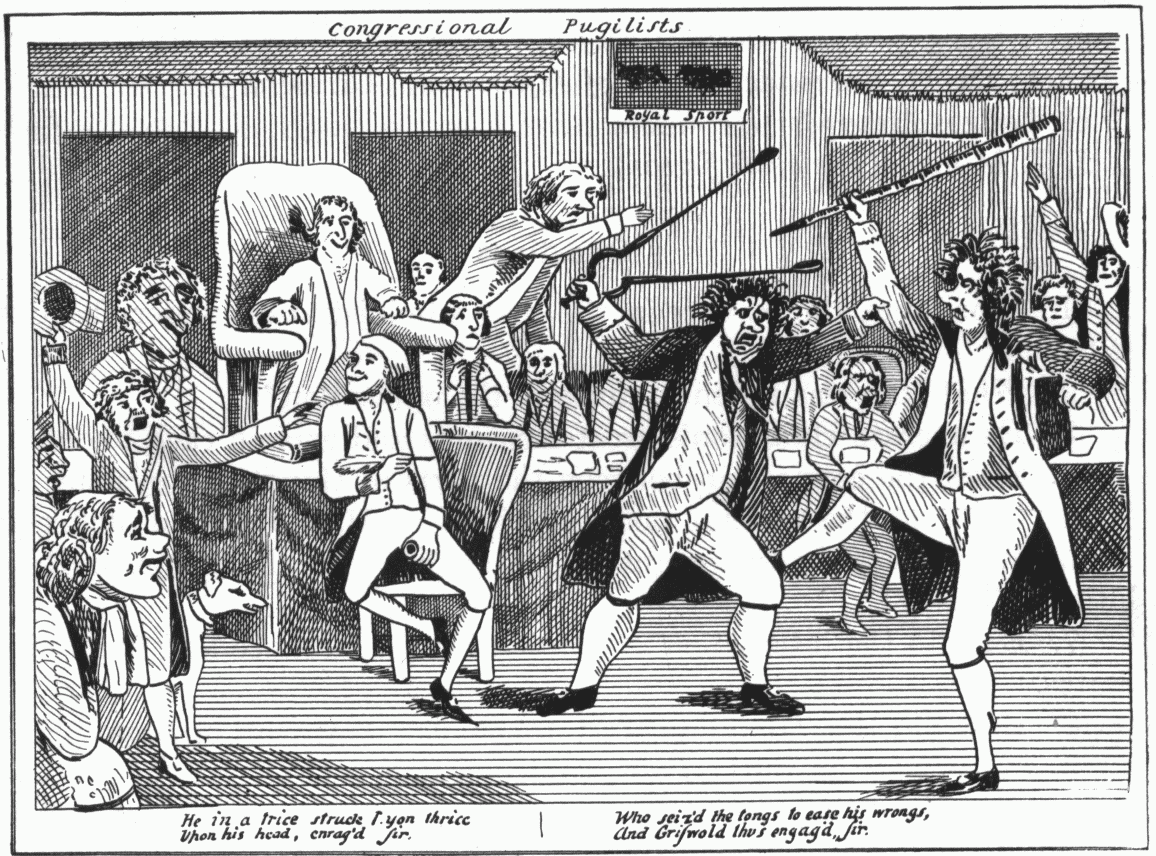

The only sure way to retain a one party system, is to oppress or outlaw any opposition. Because of the First Amendment, the government of the United States has no right to discourage criticism or opinions differing from its own. The First Amendment made the existence of the two-party system possible and allowed it to thrive. The entire nation will never agree completely on any issue, and thus different parties are natural. Violence and punishment for opposing opinions are what normally keep alternate parties from forming, but the right to free speech makes this impossible in the United States. The closest the two-party system came to collapsing was with the Sedition Act. This Federalist bill was almost tyrannical in nature, and the conviction of 10 men, who were mostly Republican newspaper editors, could have brought an end to the free speech of the Republican party. The bill itself was entirely unconstitutional. However, the new government created by the constitution was an effective one, and it did it's job. Although there was a Federalist majority in Congress, James Madison and Thomas Jefferson managed to offer resistance to the new bills with the Virginia and Kentucky Resolutions. The resolutions had the ability to tear the Union apart, but at the same time they were the epitome of "checks and balances".
The power changed from the hands of the Federalists to the Republicans in the election of 1800. Although structure of checks and balances seems not to have worked during the passage of the Alien and Sedition Acts, changing the concentration of power served to ameliorate the turmoil. Because the government switches back and forth between parties, it is a further defense against the development of tyranny. However, it can also be argued that having a two-party system causes nothing to get done. In the case of the early Republicans and Federalists, this is exactly what happened. The two parties were so concerned with proving each other wrong, that the fighting ceased to be for the good of the nation and was simply a matter of self-interest. The Alien and Sedition acts were interpreted by the Republicans as an attack against them. They came about because there were two parties, but were also destroyed by the same fact. If the United States had a one party system, would the bills still have been repealed? Would they have come about in the first place?
Thursday, October 21, 2010
Emergence of Political Parties in Early America


http://www.ts4.com/Quotes/AllQuotes.html http://www.igs.berkeley.edu/library/research/quickhelp/federal/pardon.html
In America after the American Revolution and after the ratifying of the first Constitution two political parties emerged. These parties emerged because of conflicting philosophical ideals amongst people of the nation. The two parties were the Federalists and the Republicans.
The Federalists were those who had the general belief in a strong central government and believed in a nation centered around trade and industry. The Republicans believed that the central government should be a not as predominant and America should be a country centered around agriculture and farming.
For a long time the Federalists, with their main leader Alexander Hamilton, dominated government because of the strong influence men of this party had there. Also given the fact that George Washington was president and tended to be more of a Federalist, this gave the Federalist party more influence in the government. Under the Federalist reign the national debt and the national bank were created as a part of Hamilton's plan. The Federalists truly created a nation in which the government is a part of both the political and financial aspects of life.
Naturally there was opposition to this way of running the country and Hamilton's plan. This is how the Republican party emerged and became stronger. Men like Thomas Jefferson and James Madison believed that the government was becoming too involved and was creating a dangerous governmental system.
This conflict then produced the two party system with the Republicans on one side and the Federalists on the other. In the end the Federalists had the hold on government for the early parts of America's history.
Which set of ideals is more correct the Federalists or the Republicans?
Although the Federalists made mistakes in how they handled issues of disagreements, the Federalists did what they needed to to get the country standing strong. The Federalists developed on the government outlined by the Constitution and aspects of this government withstood the the test of time.
With this being true, the Federalists also encountered many problems while in governmental power. The first major problem was the lack of control over the Western States. An example of this lack of control was the Whiskey Rebellion. As a part of Hamilton's plan he instituted a excise tax. Farmers in Pennsylvania refused to pay this tax and revolted this was called the Whiskey Rebellion. In order to stop this rebellion the Federalist government set the militia to overtake the people. The conflict never got to fighting but was this the best way to handle the rebellion? Was there a better way to deal with this uprising?
In addition to the struggle to control the outer territories, the Federalist government also faced international issues while George Washington was in office. During this time period, America faced two major problems with other countries . The first problem was the overwhelming conflict between the French and the British. In 1793 the French government went to war with the British. This presented problems among the British and America because due to the conflict with France, the British then began to seize American ships that were engaged in French trade. This problem between the Americans and the British was eventually resolved by Jay's Treaty. The other international problem that faced America was a dispute with Spain over the port of New Orleans and America's boundaries. This dispute was settled in 1795 by Pickney's Treaty.
Even though the Federalists did handle some events like the Whiskey Rebellion violently, and arguably incorrectly, they were smart in how they handled foreign relations. The Federalists made mistakes in office but they also developed a strong country and government that would last.
Subscribe to:
Posts (Atom)